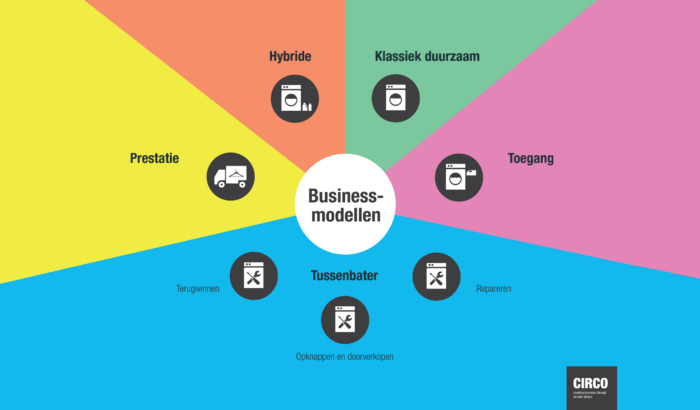
This article and accompanying videos gives a good overview of the different circular business models. What business models are there, when are they relevant, what is the revenue model and in what way are they circular?
First, the distinction between Products that Last and Products that Flow. Products that Last are products that last for a long time such as phones, furniture and machines. We also call these products consumable products. Products that Flow, or consumables, are short-lived products intended to be used once or for a short period of time. Examples include packaging, disposables and some products in the fashion industry. There are several circular design strategies for these products. You can also apply the circular business models of Products that Flow to Products that Flow.
We distinguish 5 different circular business models:
Performance- This also places the responsibility with the provider, but there is a contract based on the performance to be delivered. The provider determines which products will be used to perform the desired tasks.
Intermediary
Recovery: Facilitates take-back and collection systems to extract valuable materials from end-of-life products.
Refurbishment and Resale: Maintains and refurbishes the product when necessary and resells it.
Repair: Extends the functional life cycle of products through repairs and upgrades.
Based on generating revenue by providing access to a product, while the provider retains ownership. There is a time limit, and the products are used on a rotational basis.
Classic, Sustainable Offers a high-quality product with a long service life, with sales as the primary source of revenue. After-sales support contributes to the company’s image of quality.
Hybrid
This model works by selling relatively inexpensive products with a short lifespan that only function in combination with a high-quality product developed specifically for that purpose.
Watch the video explaining the circular business models for Products that Last here:
Watch the video explaining the circular business models applied to Products that Flow here:
These circular design business models are used in CIRCO's Tracks and Classes. These are training courses for companies and designers. These trainings also include the circular design strategies.
The circular economy does not arise by itself. CIRCO (a program of TKI-CLICKNL) focuses on getting a new market moving. CIRCO therefore activates - with the support of the government - entrepreneurs and creative professionals to (re)design products, services and business models in order to then do circular business.
 Article