September 23, 2026
Circular HVAC systems: business models, refurbishment, and a roadmap in the making
April 23, 2026
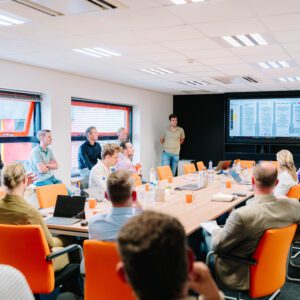
On April 9, Circonnect, DGBC, and TVVL hosted the first webinar (recording available at the bottom of the article) in a new series on circular climate control systems. Three speakers provided participants with insights into research, practical applications, and policy. A look back.
Why Installations Are Now the Focus
HVAC systems have long been overlooked in the circular economy debate. In terms of weight, they account for an average of 2 to 4 percent of a building, but a closer look at critical materials reveals that the vast majority are found in the HVAC sector. At the same time, the sector is facing a growing supply of low-cost products from outside Europe, with little prospect of reuse at the end of their life cycle.
The webinar series is part of the MOOI project "Circular Climate Systems," a multi-year research program running through June 2027. MOOI stands for mission-driven research, development, and innovation, funded by RVO. Circonnect is collaborating on this project with DGBC, TVVL, and sixteen other organizations.
Seven business models
Emma Koster (Utrecht University of Applied Sciences) opened the session with an overview of circular business models for the HVAC sector, based on a classification by the Ministry of Economic Affairs and Climate Policy (2022) that the consortium has adapted to climate control systems. She identified seven types, ranging from raw material models to lifecycle models in which a single party remains the owner throughout the entire lifespan.
The consortium views performance-based models as promising: those who offer the system as a service while retaining ownership have a direct incentive to ensure a longer lifespan and better design. A practical example is Itho Daalderop’s KlimaatGarant concept, in which indoor climate is delivered as a service and the system remains the property of the supplier.
A blind spot in the individual models, as Koster pointed out: they always describe a single party. In practice, multiple links are needed to close a loop. How, then, do you allocate costs and benefits? That will be the central theme of the next webinar, in collaboration with TNO Vector: collaborative business models.
From warranty returns to return flow
Thomas van Daal (Itho Daalderop) put the theory into practice. The company is focusing on two products as a starting point for refurbishment: mechanical ventilation units and the WPU 5G heat pump. For the ventilation units, only the core components—the motor and electronics—are replaced, while the housing and duct connections remain in place. This reduces installation work and transportation requirements. For the heat pump, the refrigeration system remains intact; wear parts such as pumps, valves, and electronics are replaced. The entire unit comes with a full warranty once again.
Van Daal was candid about the complexity. Supply and demand in a circular economy are unpredictable, laws and regulations are designed around a linear economy, and the availability of electronic components thirty years from now is uncertain. His conclusion: you just have to go ahead and do it, step by step.
A roadmap in the making
Olaf Oosting (Groen & Aldenkamp Installatietechnieken, chair of the circular HVAC product group at TVVL) concluded with an update on the Circular HVAC Roadmap. The roadmap is currently being updated based on new policy developments: the National Raw Materials Strategy, the Technology Agenda (2024), the updated National Circular Economy Program, and a publication from the Dutch Materials Observatory on the security of supply of critical materials in the installation sector.
The product group focuses on three areas: heat pumps, air handling units, and control technology. The roadmap consists of five action lines: low-installation construction, circular design, value retention, market development, and knowledge sharing. Oosting used the webinar as an opportunity to gather feedback and asked participants which actions should definitely be included. The preliminary version of the roadmap can be found on the Circular Manufacturing Industry website. The update discussed during the webinar will be published shortly.
In September: Collaborative business models in the installation sector
The second webinar will take place on September 10, 2026, during Dutch Green Building Week. Topic: collaborative business models in the building services sector, in partnership with TNO Vector. A recording of the April 9 webinar is available below.
Photo by Kettenreaktion via Unsplash