August 27, 2026
Raw material and product data as strategic business capital
November 22, 2025
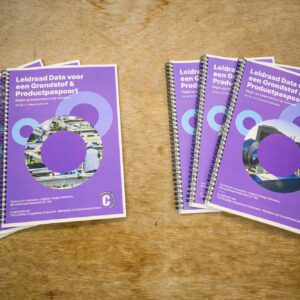
Circonnect launches the Raw Materials & Product Passport Guidelines
For entrepreneurs in sectors such as mechanical engineering and climate control systems, the playing field is changing rapidly. They are looking for ways to reduce vulnerabilities in their value chains and to make more data-driven choices that increase the competitiveness of both individual companies and chains as a whole. At the same time, they are faced with (upcoming) legislation and regulations that require them to collect and make available detailed essential raw material and product data. The manufacturing industry is thus on the eve of a data-driven transition to a circular economy.
The Raw Materials & Product Passport Guide provides insight into which data points are relevant, how they relate to legislation and regulations, and how companies can use this information to both comply with obligations and gain a strategic advantage.
Data as a means, not an end
Raw material and product data are the keys to future-proof business in the manufacturing industry. Because with insight into what your products contain, where they are, and how they are maintained, you can better manage the security of raw material supplies, cost savings, sustainability, and strategic innovation.
The guideline makes it clear that data is not a separate exercise, but a means of making products and companies future-proof. Those who know what data is requested can use that information to make better decisions about design, material use, maintenance, reuse, and recycling.
Here, the new Raw Material & Product Passport Guidelines expand on the Circular Product Passport 2.0 Guidelines. The earlier version provided an overview of relevant data, but it was unclear where exactly that data came from and why it was needed. "Ultimately, it's about collecting raw material and product data," explains Tim de Ruiter of Partners for Innovation. "What data do I need under Dutch and European legislation? And how can I use that data to ultimately make my product more circular?"
By using data intelligently, insights can be gained into where the greatest opportunities lie for making products more sustainable, cost-efficient, and value-preserving. This means that compliance with regulations automatically becomes a step toward better business operations.
The improvement perspective
For the development of the guidelines, a broad survey was conducted among stakeholders in the machine building sector (capital goods for the food industry) and among manufacturers of climate control systems. This survey revealed three main areas of need for entrepreneurs:
- Understanding legislation and regulations: what obligations apply or are coming, and what draft guidelines follow from this?
- Specific data points: what circular data should be collected (e.g., CO₂ emissions in the production phase, proportion of recycled material, origin of raw materials)?
- Room for improvement: how can collected data be used to actually improve the circular performance of products? By using this information wisely, companies can make their business operations and product development future-proof.
Our discussions during the Manufacturing Industry Meet-up on June 25, 2025 confirmed these needs. Based on input from the sector, the guidelines have been expanded and made more practical. This makes the guidelines not only a tool for reducing regulatory pressure, but also a means of seizing opportunities arising from circularity.
Collaborating in the chain
Good raw material and product data offer opportunities to strengthen competitive position, mitigate supply risks, accelerate innovation, and future-proof business processes. An important point to note is that some of the data is not available within the organization itself, but must come from suppliers. The guideline explicitly states that chain collaboration is indispensable for obtaining complete and reliable product data.
Tim de Ruiter: "The Raw Materials & Product Passport Guidelines provide insight into what a producer should know about their product and production process. They also provide insight into what everyone in the chain should know in terms of legislation and regulations, and introduce a framework for communicating this information.
For entrepreneurs, this means that compliance does not stop at their own factory gates. It requires new agreements and cooperation throughout the entire chain. This can be challenging, but ultimately also creates new opportunities: better relationships with suppliers, access to more reliable data, and room for innovation.
Compliance moving forward
"The further development and updating of the Raw Materials & Product Passport Guidelines aims to provide practical support to producers, designers, and purchasers in getting started with circular ambitions in a concrete manner based on raw material and product data. This is done in a way that directly aligns with the requirements of upcoming legislation and regulations," explains Iris Grobben (Program Manager Circonnect).
In the new version, the data points are therefore directly linked to the underlying regulations and their practical application. This creates a logical connection: you can see which law requires which information, and how that data can then be used to further improve your product or process.
New and upcoming European regulations such as the ESPR (Ecodesign for Sustainable Products Regulation), the Critical Raw Materials Act, and the Battery Regulation require companies to collect detailed essential raw material and product data and make it available via a Digital Product Passport (DPP). This also applies to manufacturers, suppliers, and installers in the climate control and mechanical engineering sectors.
Instead of reacting to new rules after the fact, the guidelines enable them to make proactive choices. This not only saves stress and costs, but also reduces the risk of errors or missed deadlines.
It is important to note that the Raw Materials & Product Passport Guidelines are not equivalent to the Digital Product Passport, which will be phased in as a requirement for various product groups in the EU starting in 2026. It provides tools to start this process in a structured way, with a focus on data points at the raw material and product level. The outcome is not only the collection of relevant product data, but also the identification of 'blind spots'.
Future-oriented entrepreneurship
The guide helps entrepreneurs to look beyond compliance and use data as a driver for innovation. Using frameworks such as the R ladder and strategies such as narrow, slow, close, and substitute, the guide shows how product data can be translated into concrete steps for improvement.
By using circular principles as a tool, companies can not only comply with regulations, but also design their products to be future-proof, strengthen their supply chain, and improve their competitive position.
The guideline forms the basis, but there is more to come. In the near future, Circonnect will launch a number of concrete tools and workshops: a design tool that links choices to circular performance, checklists and formats for systematically collecting data, and practical examples that help entrepreneurs collaborate in the chain. Starting with the product groups of mechanical engineering and climate installations.
Iris Grobben: "Because the field of Raw Material & Product Passports is still new, practical examples are very important. That is why we are making the new guidelines available first for machine construction and climate control systems; two product groups in which companies will soon be faced with new requirements regarding Digital Product Passports."
For entrepreneurs, the message is clear: circularity is not a goal, but a means to an end. Those who start working with the guidelines today are building a business that is ready for the future.
Read more about the Raw Material and Product Passport