September 23, 2026
New circular criteria bring consistency to design and procurement of air conditioning systems
November 04, 2025
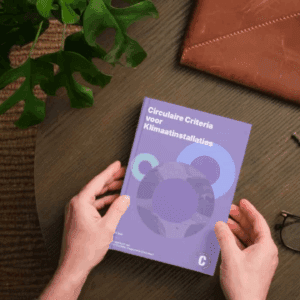
Circonnect launches guide with concrete guidelines for real estate clients
Climate systems are responsible for an increasing portion of the environmental impact of buildings. As the energy performance of buildings improves, the focus of the environmental impact shifts to the material use of installations. More complex, heavier systems and frequent replacement mean that we will not achieve climate goals such as "all homes carbon neutral by 2050" if we continue to think in terms of energy efficiency alone.
For this reason, CE Delft developed the publication "Circular Criteria for Climate Systems" on behalf of Circonnect. This guide for drawing up a circular Program of Requirements translates the principles of circularity into concrete, technically based requirements that can be applied in tendering, design and management of installations. It enables large clients in real estate, such as municipalities and housing corporations, to tender for contracts in a more focused way.
From energy to circularity
In the transition toward carbon-neutral homes, sustainable climate systems, such as heat pumps and ventilation systems, play a key role. At the same time, the production of these installations is responsible for as much as 59.8% of the environmental impact in housing renovations. By including the principles of circularity in the preparation of the Program of Requirements account, this impact can be directly reduced.
The circular criteria from the guide are the next step toward a unified approach within the sector. Instead of merely aiming for the lowest possible energy consumption, the focus within contracting is shifting to an integral approach with attention to raw material use, life extension and reuse potential.
The criteria align with the four strategies of circularity:
- Reducing resource use (narrow the loop)
- Lifetime extension (slow the loop)
- High quality processing (close the loop)
- Substitution of raw materials
In addition, they are applicable at both the system level (such as ventilation or heat pump systems) and the product level (e.g. individual components such as heat exchangers or control technology), and are consistent with the FODAR principle: Function, Generation, Distribution, Output and Control.
Five pillars for circular plants
The guide bundles technical guidelines under five main themes that together form the core of circular design and application. These principles help clients in setting policy and strategy, in making agreements with co-makers and market parties, and in market solicitations and tenders.
- Integral design - Design the building climate-responsive and utilize passive principles (such as thermal mass, natural ventilation or shading) to reduce active installations.
- Detachability - Assemble components disassembled, with measurable requirements according to the Detachability Index (minimum 0.6 for connection type and accessibility). Establish a disassembly manual and involve maintenance and disassembly parties in the design.
- Adaptive capability - Design installations that can adapt to changing uses or functions of the building, for example, with flexible control technology and variable speed of components.
- Reuse and reuse potential - Promote use of remanufactured products and record provenance in a materials passport. This keeps information about parts available for future use.
- Optimizing service life - Extend service life through maintenance, repair and weather protection. Suppliers should keep parts available for at least 10-15 years and provide a repair manual.
Pilot projects: learning in practice
During the development of this Guide to Circular Climate Installations, a number of previous initiatives in the field of PoAs for circular climate installations were brought together. By pooling knowledge, experience and concrete tools, the application of circular principles within climate systems is taken another step forward.
One such initiative is the Program of Requirements (PoR) for circular climate systems for housing corporations by Squarewise and C-creators that they developed earlier this year together with housing corporations, market players and knowledge institutions.
In collaboration with Squarewise and C-creators, the guidelines will be validated this fall through two practical pilots in which the technical frameworks drawn up will be tested against actual design and tendering situations of housing associations de Alliantie and Woonin. In the pilot the guidelines and the PVE will be applied, examining which elements overlap and which complement each other. This will show how circularity can actually be integrated into both technical specifications and project processes.
Towards consistency and scaling up
Based on the results of the pilots in renovation and new construction projects of housing corporations, Circonnect's guideline will be further updated and made available in an open source Do It Yourself (e-learning) and through Do It Together workshops where you work with the guideline in a group.
At the same time, the insights are being fed into the learning community for circular climate installations that Circonnect, C-creators, Squarewise and the consortium partners of the Circular Installations Innovation Project are building together.
The new criteria provide more consistency in both the request for tender and the assessment. Large clients such as municipalities, corporations and real estate owners can specify circular performances in an unambiguous way.
With this guidance document, Circonnect is setting a new standard with the industry, striving to connect fragmented initiatives into a cohesive, testable approach to circular climate systems - an essential step toward a future-proof built environment.