September 23, 2026
Textiles on the Move: From Dutch Brands to International Chains
June 4, 2026
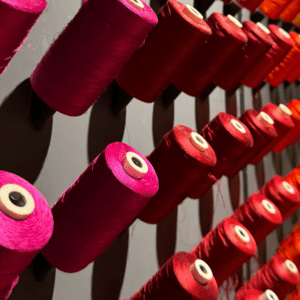
A growing number of companies in the textile sector—including Dutch clothing brands, designers, and industry stakeholders—are increasingly recognizing the benefits of circular practices. Not because they have to, but because it helps. How do you extend the lifespan of your products? How do you reduce fabric surpluses at your manufacturers? What do you do with unsold inventory and returns? And how do you make agreements with suppliers regarding environmental impact, and how do you measure that impact in the first place?
These are not abstract questions: they come directly from the front lines of Dutch textile companies that are working with their supply chains. At the same time, they know what’s coming: UPV, ESPR, and the mandatory Digital Product Passport. Since the launch of the CIRCO program, Circonnect has been contributing to this movement: working with individual companies, supply chains, and the sector as a whole. At the company level, concrete steps have been taken and a track record has been established through case studies, collaborations, and tools. The next step: systematically expanding this approach to the supply chain and sector levels, with a strong international dimension.
New products and circular business models from the CIRCO Tracks
Over a decade of CIRCO Tracks in textiles has yielded a wide range of circular strategies. HAVEP investigated how circularity can be integrated within the strict safety requirements of protective workwear. Emma Safety Footwear explored shoes-as-a-service. Feelou developed a circular maternity bra where product development and behavioral change go hand in hand. What these initiatives consistently reveal: circular ambitions quickly touch on the supply chain. Who is responsible for take-back, how return logistics work, what materials are in a product—these are not design problems, but supply chain challenges.
You can see that participation in a CIRCO Track continues to have an impact even after the program ends—sometimes more directly than others. ASICS, which participated in 2020, began incorporating recycled materials on a large scale into new running shoes starting in 2021 and, in 2024, launched the NEOCURVE in collaboration with Fast Feet Grinded—a sneaker designed entirely with recycling in mind.
In 2022, ByBorre introduced Textile-as-a-Service via the Create platform: a digital design tool that allows brands and designers to design from the yarn up, with direct access to circular knitting machines. All fabrics come with a Textile Passport that provides insight into origin, composition, and recyclability.
Whether and to what extent the CIRCO Track directly prompted these steps varies from company to company, but the trend is consistent: once companies have fully embraced the principles, they take concrete steps even outside the program.
From workwear to the entire industry
The partnership between Circonnect and Modint, the trade association for the Dutch fashion and textile sector, began in 2019 with CIRCO Tracks focused on workwear. This is a segment where supply chain collaboration is relatively easy to organize due to its B2B structure and the practical possibilities for collection at the client’s premises. These tracks yielded very concrete insights and initiatives regarding reverse logistics and high-quality recycling.
The collaboration now has a much broader scope. The organization aims to help its 400 members—ranging from small fashion brands to major players—take concrete steps toward circular business practices, partly driven by the ESPR. Under this European regulation, requirements regarding product design, material transparency, and traceability will soon apply to virtually all physical products on the European market.
The joint training puts this into practice. Participants analyze their own supply chain, identify value loss, and formulate a mission statement for their organization. The questions that arise in the process are familiar to anyone working in the sector: How do we establish vintage and secondhand items as an integral part of our retail model? How can we launch a repair program and inform customers about it? How do we guide our designers toward recyclability, monomaterials, and recycled content? Two Modint trainers, trained in the CIRCO methodology, lead the training and continue to support participants afterward based on their long-standing relationship with the members. This is supplemented by an annual Next Steps day organized by Modint and Circonnect for all former participants, to ensure progress and facilitate next steps.
The Raw Material Product Passport for Textiles
One of the practical tools Circonnect is developing for the sector is a textile version of the Raw Material Product Passport (RMPP). The guidelines for the sector will be available shortly. The GPP brings together data on materials and products into a single traceable overview. For textiles, this includes fiber composition, non-textile parts of animal origin, the EUDR-relevant origin of wood fibers such as viscose, care and maintenance instructions, repair instructions for users or professionals, and take-back and collection routes. In doing so, it offers practical preparation for the Digital Product Passport, which will become mandatory for textiles under the ESPR. Those who wait until that deadline will be too late: data collection across the entire supply chain is a time-consuming process that requires supply chain agreements. With the guidelines, companies can map out relevant data step by step.
International: The supply chain doesn't stop at the border
The Netherlands actually has very few actual textile manufacturers. The designers, brands, and buyers are based here—the factories are located in Asia, North Africa, or Eastern Europe. The supply chain of a Dutch clothing brand almost always extends internationally, making international supply chain collaboration not just optional but structurally necessary for this sector.
This was also evident during the ESPR training: virtually all participating brands have suppliers in Asian manufacturing countries. There was immediate interest in a potential international Supply Chain Track. Circonnect is currently exploring the possibilities for this in collaboration with Modint, international partners, and CIRCO Hubs in textile-producing countries such as Bangladesh, Sri Lanka, Turkey, and Portugal.
The international Hub network also focuses on textiles: CIRCO Hub Flanders is already active at the intersection of textiles and interior design. In May of this year, they launched a CIRCO Track for Wood, Furniture, and Textiles.
Photo: Zhengchao An via Unsplash