October 27, 2026
Roadmap for Circular Climate Control Systems: The Path to 2030 Takes Shape
September 23, 2026
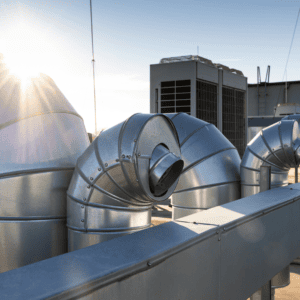
On September 10, DGBC, TVVL, and Circonnect hosted the second webinar in the series on circular HVAC systems. The focus was on what the updated Roadmap for Circular HVAC Systems means for the market. In addition, two speakers—Kristiina Sau of TNO and Eelke Bontekoe of Inside-Out—outlined two practical approaches that warrant further exploration.
From Policy Document to Market
Approximately 40% of the environmental impact of buildings is attributable to building systems, with HVAC systems accounting for the largest share. As the energy performance of buildings improves, the focus of that impact is shifting from energy consumption to material use. This makes HVAC systems—long a blind spot in the circular economy debate—one of the sectors where gains can be made.
The first webinar in the series, held on April 9, focused on circular business models for the sector. Emma Koster (Utrecht University of Applied Sciences) identified seven types of models, ranging from raw material models to monetization. She pointed out a blind spot even then: these models always describe a single party, whereas a circular economy usually requires multiple links in the chain. So how do you distribute costs and benefits fairly? That question was the direct impetus for this second webinar.
The webinar series is part of the MOOI project “Circular Climate Control Systems,” a multi-year research program that runs through June 2027 and is funded by RVO. Circonnect is collaborating on this project with DGBC, TVVL, and sixteen other organizations.
The Roadmap: From Strategy to Action Plans
In July, the seven roadmaps for the manufacturing industry—including HVAC systems— officially became part of the implementation of the National Raw Materials Strategy. This marks the end of the joint development phase and the start of implementation. Olaf Oosting (Groen & Aldenkamp Installatietechnieken, chair of the HVAC product group at TVVL) explained to participants what the June 2026 update specifically means for the market.
The roadmap outlines a path toward 2030 and is based on five action areas: low-installation construction, circular design, value retention, market development, and knowledge sharing. New compared to previous versions is a fourth substantive goal, in addition to lower environmental impact, a longer service life, and a higher recycling rate: 15% of the demand for critical materials must be met through recycling by 2035, in order to reduce dependence on a limited number of supplier countries. Oosting described this target as the result of the product group’s own input, supplementing the objectives set out in the National Circular Economy Program.
According to Oosting, data is the most important lever for steering policy—not as an end in itself, but as a means to an end. Data on critical materials, in particular, is still lacking, while the sector’s focus has traditionally been primarily on energy consumption. In that light, he welcomed the European Critical Raw Materials Act, which is intended to increase the security of supply for critical raw materials.
The roadmap focuses on generation, distribution, delivery, and control technology, thereby recognizing that a climate control system is not a standalone product but a system. According to Oosting, what distinguishes this sector from, for example, the roadmap for electrolysers is the supply chain surrounding it: contractors, architects, and permitting authorities are just as much a part of the playing field as manufacturers and installers. This makes standardization more complex, a point emphasized by RVO during the webinar: the materials used in systems do not scale linearly with capacity; a 20-kW heat pump does not automatically require twice as many materials as a 10-kW model.
For several years now, Circonnect has been empowering and supporting companies in this product group to adopt a forward-looking approach to business, including through a number of CIRCO Supply Chain Tracks in the field of HVAC systems. For air ducts, a project has been underway since 2025 in collaboration with OostNL and Maaklos, and now includes pilot projects at companies such as Heijmans, GMM Luchttechniek, and Kerssens Luchtbehandeling. Currently, there is also a Supply Chain Track focused on heat recovery systems, starting with seven pilot projects. Both are examples of how value retention—one of the five action lines outlined in the roadmap—is taking shape in practice.
Two practical tracks for further study
Kristiina Sau (TNO) introduced collaborative business modeling as a method for getting to the bottom of the very issue discussed in the April webinar: how do you distribute value, costs, and risks fairly among multiple parties when none of them can implement a circular solution on their own? The method starts with a shared goal, then identifies all parties involved, and specifies for each party the specific contributions, activities, and benefits associated with that goal. Value here does not necessarily mean money; it can just as easily refer to knowledge, community value, or CO2 reduction. According to Sau, the potential lies precisely in issues that are too complex for any single party to handle alone—such as the modular refurbished ventilation unit discussed in the April webinar—where a workable and fair model can only emerge through the contribution of every link in the chain, from the housing authority to the refurbisher.
Eelke Bontekoe (Inside-Out) demonstrated how this works in practice, using Bravo as an example—a collective heating system that replaces individual gas boilers in multi-story buildings. Eight parties are involved, ranging from the housing authority as the heat supplier to the grid operator, who can temporarily shut down the system in the event of grid congestion. Bontekoe was candid about an unresolved issue: the housing authority bears the higher initial investment, while a large portion of the benefits—lower energy costs—goes to the resident, who is also protected under tenancy law. A solution is being worked on, in collaboration with housing authorities and BOEX, among others, but it has not yet been finalized.
Both presentations touched on the same issue that Olaf Oosting raised earlier: how do you balance material use and energy performance when both, literally, last for decades? Participants also raised that question in a different form, namely to what extent a changing climate is already taken into account when sizing systems, and whether Dutch standards should be adapted accordingly. Both topics—collaborative business models and Bravo’s approach—deserve more attention than this webinar could provide. We will revisit them in a follow-up article.
Getting started yourself
Anyone who wants to get started with these considerations right away can refer to the Circular Criteria for Climate Control Systems, the guideline that Circonnect developed in collaboration with CE Delft for real estate clients. The criteria align with the same systems-based approach described by Oosting, based on the FODAR principle: Function, Generation, Distribution, Delivery, and Control. In this way, they offer municipalities, housing authorities, and other major clients concrete steps to begin implementing a circular Statement of Requirements today, in anticipation of the goals outlined in the roadmap.
Outlook
Developments in the field of HVAC systems will be featured in several venues over the coming months. This month, a TVVL magazine will be published featuring Bravo; in November, TVVL will host Techniek Today; and on December 10, a breakout session on predictive maintenance will take place during the Paris Proof conference. The next webinar in the series is scheduled for February 11.
You can watch the recording of the September 10 webinar below.